
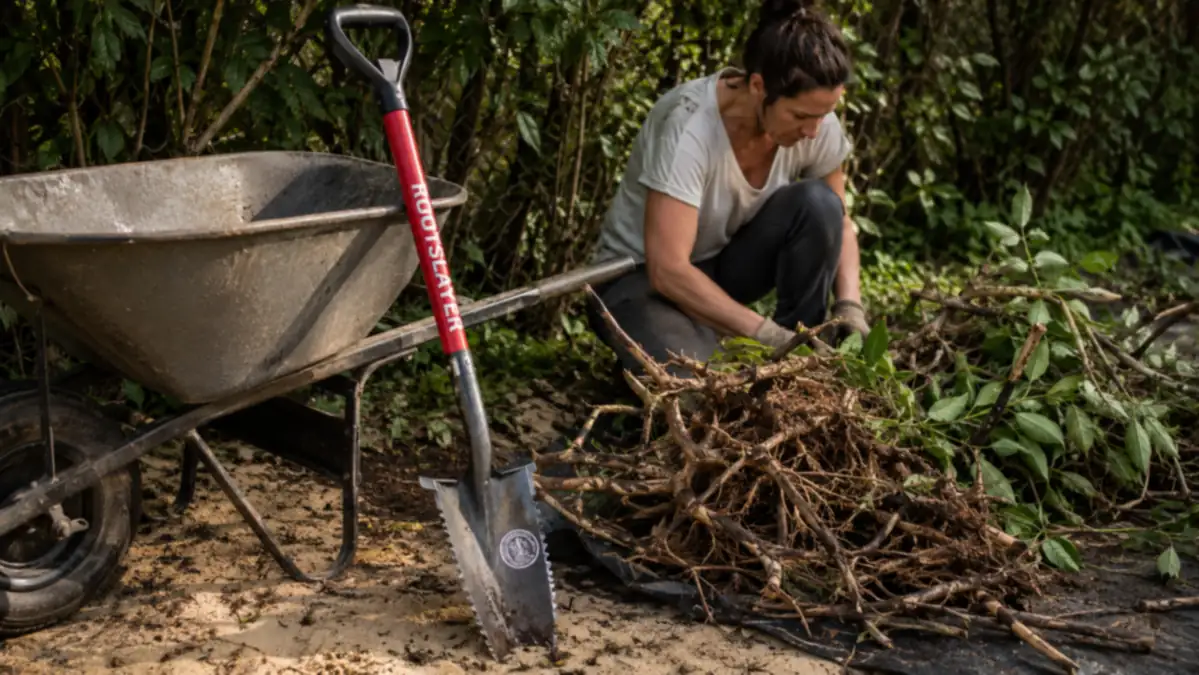
I'll say the part most reviews leave out first. My forearms were sore for two days after my first real session with the Root Slayer, and the box it shipped in arrived with one corner crushed enough that I checked the blade twice for a bend before I ever put it in the ground. Those aren't the details you find in a five-star review that just gushes about how well the serrated edge saws through roots. I bought mine about eighteen months ago to deal with an old privet hedge row that had sent roots halfway into my vegetable bed, and I've used it on and off ever since.
My yard isn't the heavy clay you might expect from other reviews of this shovel. It's mostly sandy loam with an annoying seam of buried landscaping rock running through the side yard, left behind by whoever owned this house before me. Different soil, different problems, and honestly a different set of gripes than you'll usually read. This is the honest version, drawbacks first, and then the parts that actually made me keep reaching for it.
The Quick Verdict
It genuinely cuts through roots better than a standard spade, but the weight, the price gap, and a few rough edges out of the box are worth knowing before you order one.
Amazon Check Today's Price →Wondering if the Root Slayer's serrated blade earns its price, or just its hype?
I'm not going to pretend it's flawless. But after eighteen months of pulling hedge roots and lilac suckers, here's where it actually delivers. Check today's price on Amazon before you decide.
Amazon Check Today's Price on Amazon →How I've Used It
The job that pushed me to buy this shovel was pulling out a privet hedge row along the side fence. The previous owner had let it grow into a tangle of thick, woody roots that ran under the fence line and into the edge of my vegetable bed, and my old flat spade had already chipped its edge trying to deal with it. I figured a serrated blade built specifically for roots was worth trying before I rented anything bigger.
Since then it's become my go-to for anything underground and stubborn. I used it to dig out a colony of lilac suckers that kept popping up through the lawn from a neighbor's tree, to divide an overgrown hosta clump that had wedged itself against a rock border, and for general digging whenever I'm not sure what I'll hit below the surface. That's roughly eighteen months of intermittent use, not one continuous season, which matters because it means I've had time to see how it holds up between long gaps in the shed.
I want to be upfront that this isn't a tool I use every week. Most homeowners won't. It's a specialty digger you reach for when a job calls for it, and that changes how you judge things like edge retention and rust, because mine sits idle for a month or two at a stretch between projects.
The Weight Nobody Warns You About
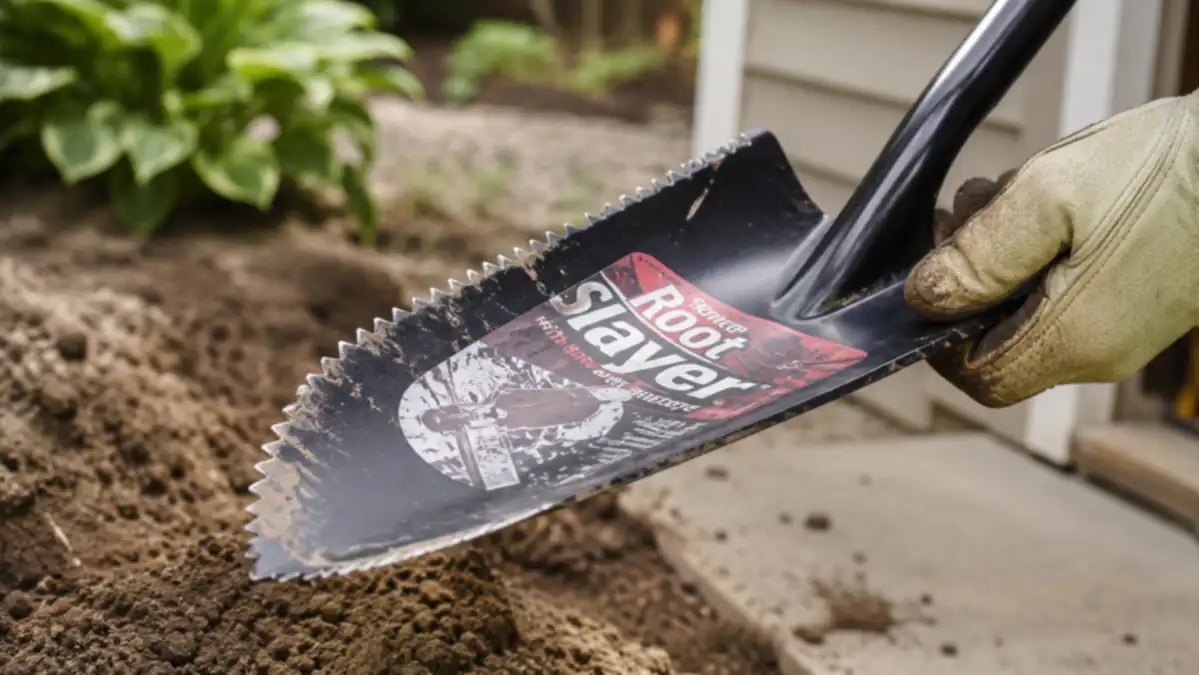
Here's the first thing that surprised me, and it's the thing I almost never see mentioned in the glowing reviews. This shovel is noticeably heavier than a standard flat spade, and the listing photos don't do a great job of communicating that. I'm not a small guy and I still felt it in my shoulders after the first afternoon working the privet roots, switching between prying, sawing, and lifting root balls out of the hole.
It's not that the weight is unreasonable for what the tool does. A shovel built to saw through roots needs a sturdier blade and a solid shaft, and that adds heft. But if you're picturing something you can swing around all afternoon the way you would a lightweight border spade, recalibrate that expectation now. By the time I finished the hosta division job, my hands were more tired from gripping a heavier tool through repeated prying motions than from the actual digging.
My wife tried it for about ten minutes on the lilac suckers and handed it back, not because it didn't work, it did, but because she found the extra weight tiring compared to her usual hand trowel and lighter spade. If you've got a smaller frame or you're doing a lot of digging in one sitting, that's a real factor, not a footnote.
There's also a balance issue worth mentioning that I didn't expect. Most of the weight sits up in the blade rather than being spread evenly down the shaft, so when I'm carrying it any real distance, say from the shed to the far side of the property, it wants to tip forward in my grip in a way a lighter, more evenly balanced spade never does. It's a small thing until you're hauling it back and forth across a bigger yard for the third time in an afternoon.
Sharpness Out of the Box, and After Real Use
Out of the box, the serrated teeth are genuinely sharp, sharp enough that I nicked a glove on the first day just handling it wrong while I unpacked it. That first impression is a big part of why the reviews are so glowing. It bites into roots almost immediately with very little effort compared to a flat edge.
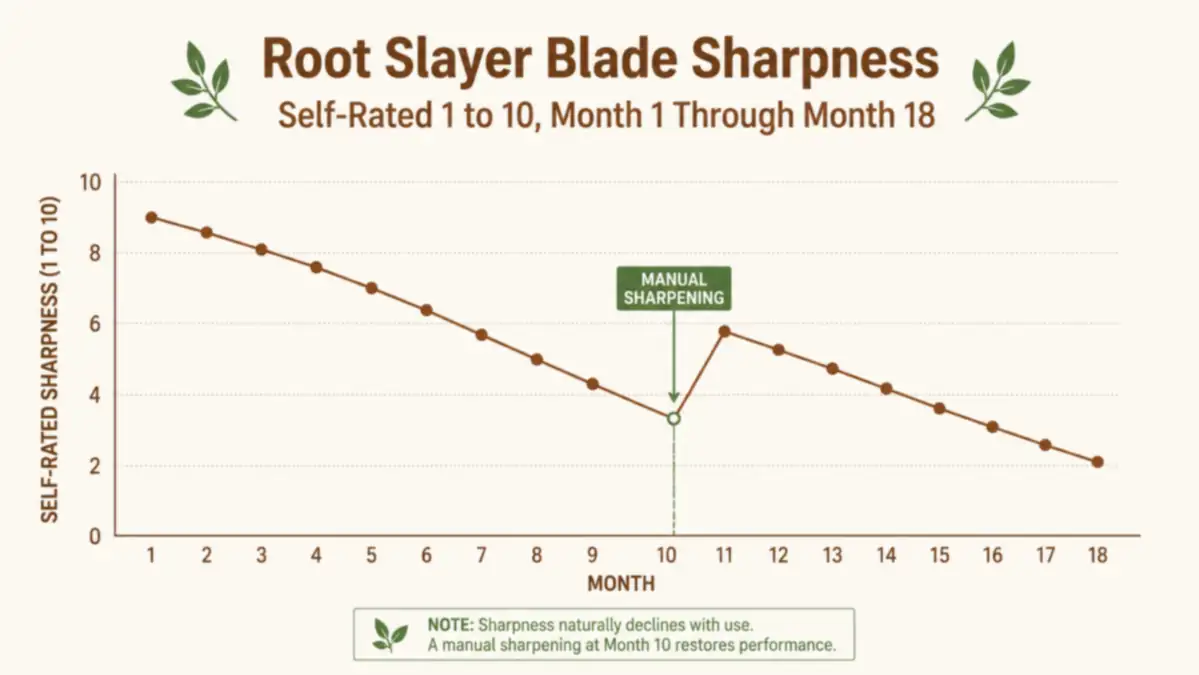
What surprised me is how much that sharpness faded once I hit the buried rock seam in my side yard. I wasn't trying to cut rock, but a shovel blade going into rocky sandy soil is going to scrape against stone whether you mean to or not, and by month six the teeth had visibly dulled compared to how they cut early on. Roots that would have parted in one or two saws in month one were taking noticeably more effort by midsummer of the second season.
I ended up running a metal file across the teeth around month ten, which brought back a decent amount of the cutting performance, but it's not something the listing tells you to expect. If your soil has any rock in it at all, plan on touching up the edge yourself at some point rather than assuming the factory edge lasts forever.
I compared notes with a neighbor who bought the same shovel around the same time but gardens entirely in raised beds filled with bagged soil, no buried rock anywhere near him. His blade still looks close to factory sharp after roughly the same stretch of ownership, which tells me the dulling I ran into probably has more to do with what's under my particular soil than any flaw in the steel itself. Worth thinking about if you already know what your own ground is hiding.
What It Costs You Compared to a Standard Spade
I'm not going to quote a number here since prices shift, but I will say plainly that this shovel runs meaningfully more than a basic flat spade at the hardware store. That's worth sitting with before you buy, because if your yard is mostly soft, root-free soil, you're paying a premium for a capability you might rarely use. I laid out a fuller side-by-side of where each tool wins in a separate piece comparing the Root Slayer against a standard garden spade, if you want the direct comparison rather than my general impression here.
For me, the extra cost paid for itself the day I hit the privet roots and my old spade just bounced. But I want to be honest that if I only dealt with roots once every couple of years, I'd have a harder time justifying it over borrowing a root saw for the occasional job. It's a specialty tool priced like one, not a general-purpose spade that happens to also cut roots.
I also priced out keeping my old flat spade and just adding a cheap separate root saw for the occasional stubborn root, instead of spending more on this shovel. Once I added up both tools, the total cost landed close to what I paid for the Root Slayer alone, and it meant carrying two things out to every job instead of one. For me the math worked out close to even, so the real deciding factor ended up being convenience rather than any savings.
Packaging and the Small Stuff That Bugged Me
The box showed up with a crushed corner, and while the shovel itself was fine, it made me nervous enough that I inspected the whole blade before I trusted it near my hands. That's a shipping issue more than a product issue, but it's the kind of thing that colors your first impression and nobody mentions in a review written the same week they bought it.
There was also a thin plastic edge guard over the teeth that came loose in transit and I nearly missed it in the packing material, which would have been a nasty surprise reaching into the box. The hang hole at the top of the handle is positioned in a spot that made it awkward to hang on the same hooks as my other long-handled tools without it swinging into whatever's next to it in the shed. None of these are dealbreakers, but they're the kind of small annoyances that add up on a tool you're paying more for.
None of the shipping trouble affected how the tool actually performed once I got it out of the box, and to the seller's credit, a quick message got a reply acknowledging the damage, though I never ended up needing a replacement since the blade itself checked out fine. Still, if you're ordering this as a gift or for someone who isn't going to inspect it carefully, it's worth opening the box yourself first and looking it over before you hand it off.
Where It Actually Won Me Over
With all that said, I keep reaching for this shovel, and that matters more than any list of gripes. On the privet root job, it saved me what would have been a rental fee for a root saw or a much longer afternoon with loppers and a flat spade taking turns. The serrated edge worked through roots up to about an inch without asking for a second tool.
The lilac sucker colony was a different kind of test, lots of smaller roots spread across a wider area rather than one thick tangle, and the pointed tip made it easy to work the blade in at an angle and pop individual suckers out without tearing up the surrounding lawn too badly. That's the kind of job where a flat spade tends to either miss the root entirely or take out a bigger chunk of turf than necessary.
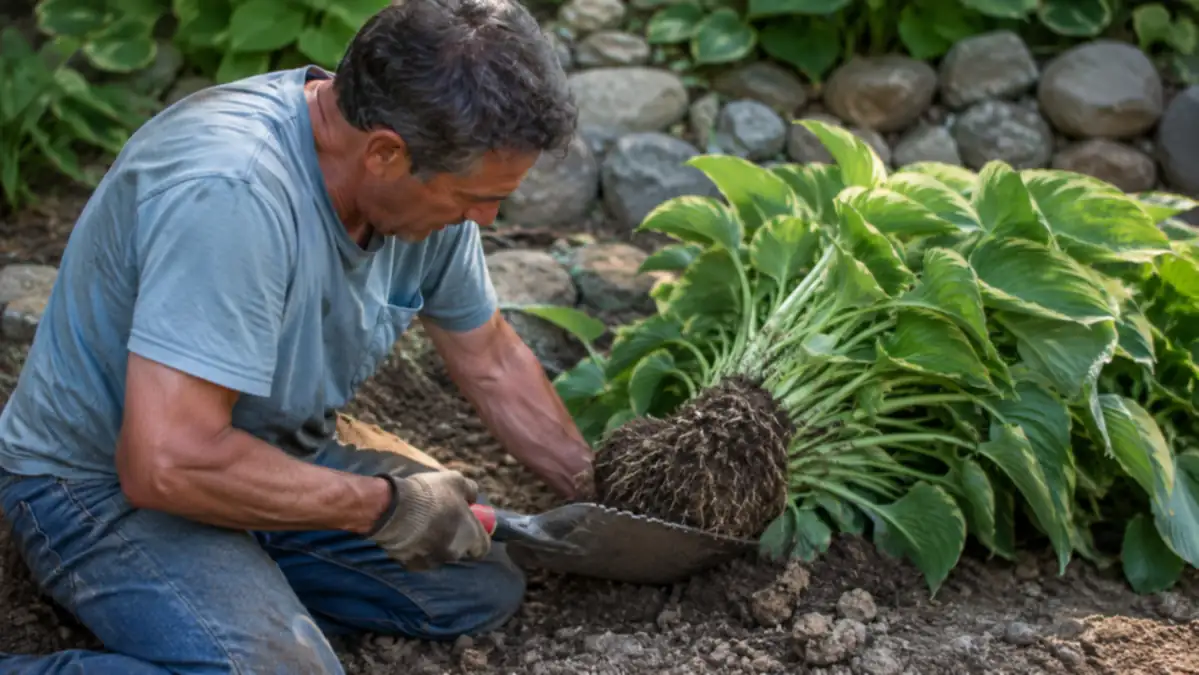
Dividing the hosta clump against the rock border showed off the tip design again, wedging into a tight gap between roots and stone where a wider blade simply wouldn't have fit. If you want the fuller story of how it performed across an entire digging season rather than the scattered jobs I've described here, I wrote that up separately in my long-term Root Slayer review after using it through months of steady work in heavier soil.
There was one smaller job I almost forgot to mention, prying up a section of old paver edging that had settled into the soil along my front walkway. That wasn't a root job at all, but the pointed serrated tip worked as a decent makeshift pry bar in that tight gap between paver and dirt, which isn't a use I expected when I bought this specifically to deal with roots.
What I Liked
- Serrated edge genuinely outperforms a flat spade on roots up to about an inch thick
- Pointed tip gets into tight spots a wider blade can't reach
- Solid steel build feels sturdier than the average hardware store spade
- Handled a stray hit or two on buried rock without chipping or bending
- A metal file restored most of the cutting edge when it dulled
Where It Falls Short
- Noticeably heavier than a standard spade, tiring on long sessions
- Blade dulls faster than expected in soil with any rock in it
- Costs meaningfully more than a basic flat spade
- Shipping box arrived damaged with a loose edge guard inside
- Awkward hang hole placement for shed storage next to other tools
It's not a bad tool. It's just not the effortless miracle the five-star reviews make it sound like.
Who This Is For
If you've got a hedge, tree, or shrub with roots that keep wrecking your digging plans, or you're removing suckers and root-bound perennials on a semi-regular basis, this earns its keep. It's also a reasonable pick if your soil has some rock mixed in and you don't mind occasionally touching up the edge yourself. Anyone who's already fought a flat spade and lost will understand the appeal fast.
Who Should Skip It
If your digging is mostly soft, open soil with few roots to speak of, save your money and stick with a lighter standard spade, you won't get enough use out of the serrated edge to justify the extra weight or the extra cost. Anyone with shoulder or wrist issues should also think twice, since the added heft is real and shows up fast on back-to-back digging sessions. And if you're expecting factory-sharp performance to last indefinitely without any upkeep, temper that expectation before you buy.
Still deciding if the Root Slayer is worth it for your yard?
It's heavier than a standard spade and it isn't cheap, but on real root and sucker removal jobs it earned its spot in my shed. See today's price on Amazon and judge for yourself.
Amazon Check Today's Price on Amazon →