
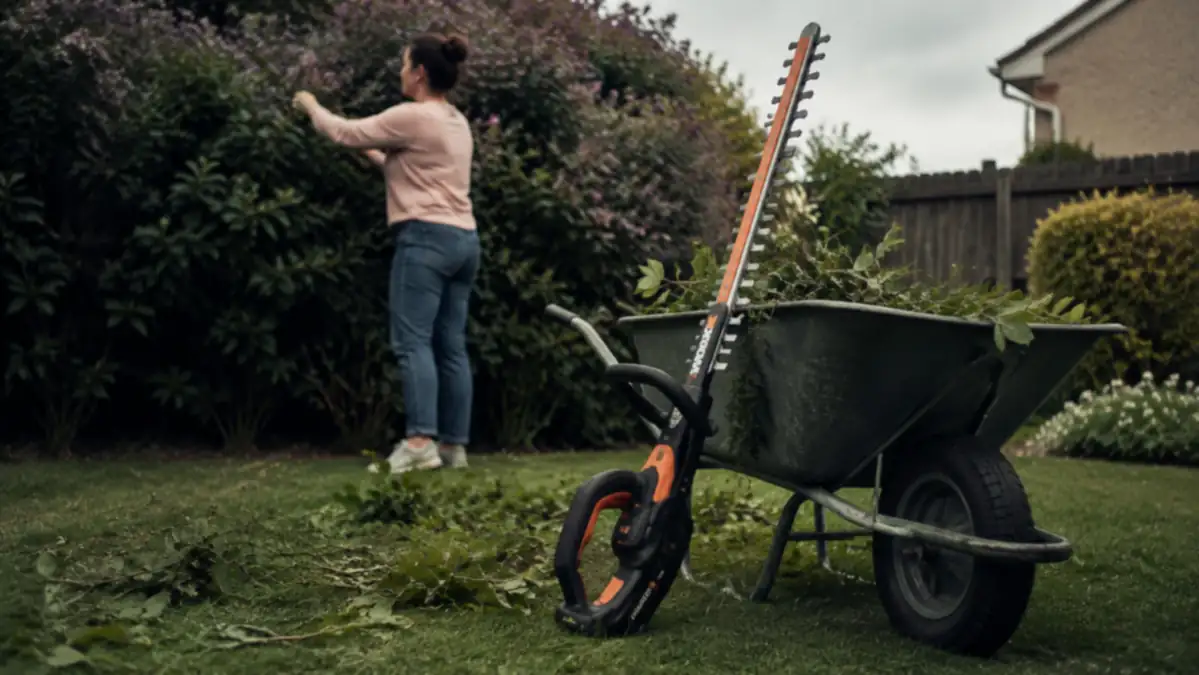
I want to start with the two things the Amazon listing for the WORX 22 inch cordless hedge trimmer does not mention, because that's the review I always go looking for and rarely find. First, it comes with exactly one battery. Second, that single battery takes a real chunk of an afternoon to charge back up once it's spent. Neither of those facts is buried or hidden, they're just not the kind of thing a glossy product photo tells you, and I only found out the hard way, standing halfway through a lilac hedge with a dead battery and forty feet of arborvitae still waiting.
I bought this trimmer to deal with a leggy forsythia hedge and a lilac screen that had gotten away from me two summers running, plus a run of arborvitae along the back fence that my neighbor Gail asked me to help her tackle when her own trimmer gave out. So this review isn't a first-impressions unboxing. It's what I noticed after using it on three different hedge types, in two different yards, over a stretch of weeks where I had every reason to find its weak points.
The Quick Verdict
A capable, lightweight cordless trimmer with a genuinely clean cut, held back by a single included battery and a charge time that will interrupt a big job if you don't plan for it.
Amazon Check Today's Price →Tired of a trimmer that quits halfway through the job, or shears that leave your hands aching?
This one earned a permanent spot in my shed despite its quirks. Check today's price on Amazon and see if it fits your yard before your hedges get ahead of you again.
Amazon Check Today's Price on Amazon →How I Actually Tested It
I didn't just run this trimmer through one tidy afternoon and call it a review. I used it on my own forsythia hedge in early spring, then again on the lilac screen along my side fence about six weeks later once the new growth had filled in, and then I borrowed a Saturday to help Gail take her arborvitae privacy hedge back into shape. Three different hedge types, three different growth habits, and one honest attempt to see where a budget-friendly cordless trimmer actually runs out of steam.
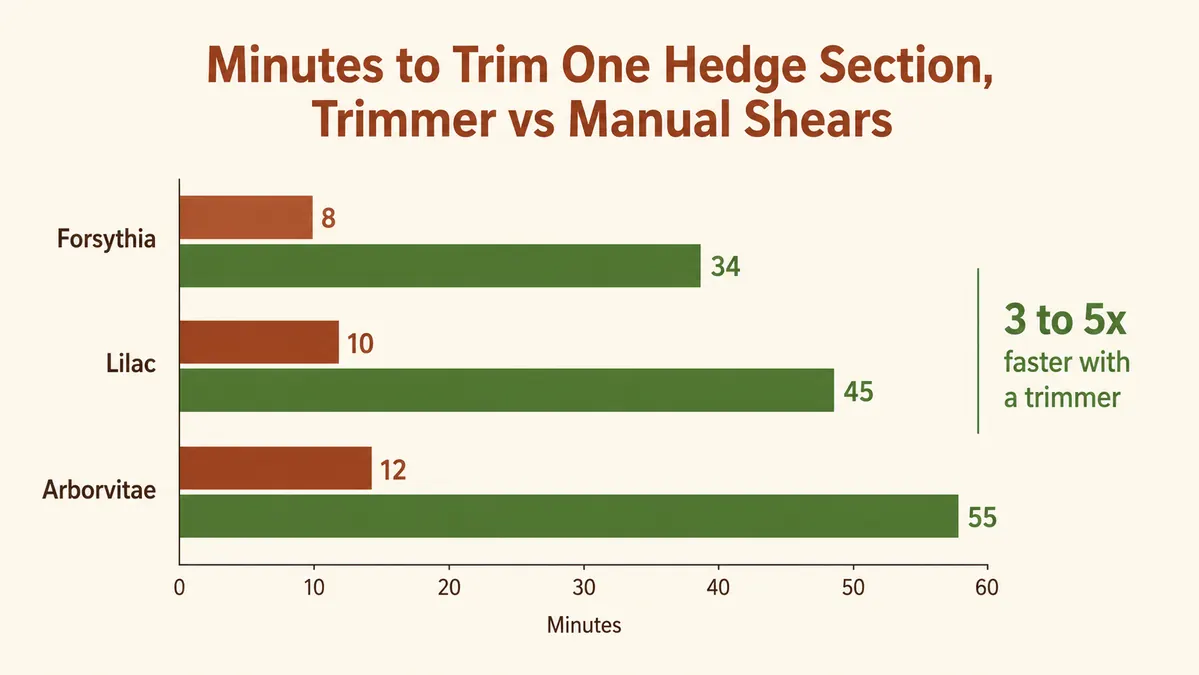
I timed each section with my phone, not because I'm obsessive about stopwatches, but because I wanted real numbers instead of a vague feeling of it seemed fast enough. I also made a point of comparing it against the pair of manual shears I'd used on the same lilac hedge the year before, since that's the honest baseline most home gardeners are actually working from, not some professional gas rig.
I also paid attention to things a lot of reviews skip over entirely, how loud it was at seven in the morning before Gail's kids were up, how the trimmer felt after sitting unused in the shed for three weeks between sessions, and whether the included charger cable was long enough to reach an outdoor outlet without me stringing an extension cord anyway, which would have defeated half the point of going cordless in the first place.
What I found is a tool that's genuinely good at the job it's built for, shaping and maintaining hedges with fine to medium branches, but with real limits that a five-star average rating tends to smooth over. I'd rather tell you about those limits up front than have you discover them mid-hedge like I did.

What the Listing Doesn't Tell You
The single battery is the big one. Most cordless outdoor tools in this price range ship with one battery, so it's not unusual, but it's worth saying plainly because it changes how you plan a big trimming day. On the Saturday I helped Gail with her arborvitae, we got through about two thirds of the run before the battery indicator dropped to empty. We had to stop, plug it in, and find something else to do for close to ninety minutes before it was topped back up enough to finish. If you've got one big overgrown hedge to tackle in a single sitting, budget for that gap or plan to split the job across two days.
The second thing nobody mentions is how the trigger safety switch feels after twenty straight minutes. WORX built in a two-handed trigger system, you have to keep pressure on a switch near the rear handle at the same time as the main trigger, which is a smart safety feature that keeps the blades from engaging accidentally. But holding that rear switch down continuously does start to fatigue your hand faster than a single-trigger tool would, especially if you've got any grip weakness from arthritis or an old wrist injury. It's not a dealbreaker, it's just something the marketing photos never show you, because nobody photographs hand cramps.
There's also a smaller detail worth flagging, the blade guard that ships with it is a snap-on plastic cover, and mine developed a hairline crack after being tossed in my garden bin a few too many times over the season. It still does its job of covering the blade teeth, but it's not built for rough handling, so if you're someone who tosses tools in the back of a truck rather than hanging them up, treat that guard gently.
And one more small thing that surprised me, the charger cable itself is on the short side, maybe five feet, which was fine at my own potting bench near the garage outlet but meant Gail had to run a short extension cord to her nearest exterior plug anyway. If your charging spot isn't right next to an outdoor outlet, plan on needing an extension cord for the charger even though the trimmer itself never needs one while you're actually cutting.
Where It Genuinely Struggled
The arborvitae was the real test, and it's where I saw the trimmer's limits most clearly. Arborvitae branches are thin individually, but they're dense and interwoven, and on the thicker interior growth near the trunk, the blade would occasionally catch and need a second pass rather than slicing clean through on the first pull. That's not a defect, it's just an honest limitation of a 22 inch blade built for regular shaping rather than heavy structural cutback on a neglected hedge.
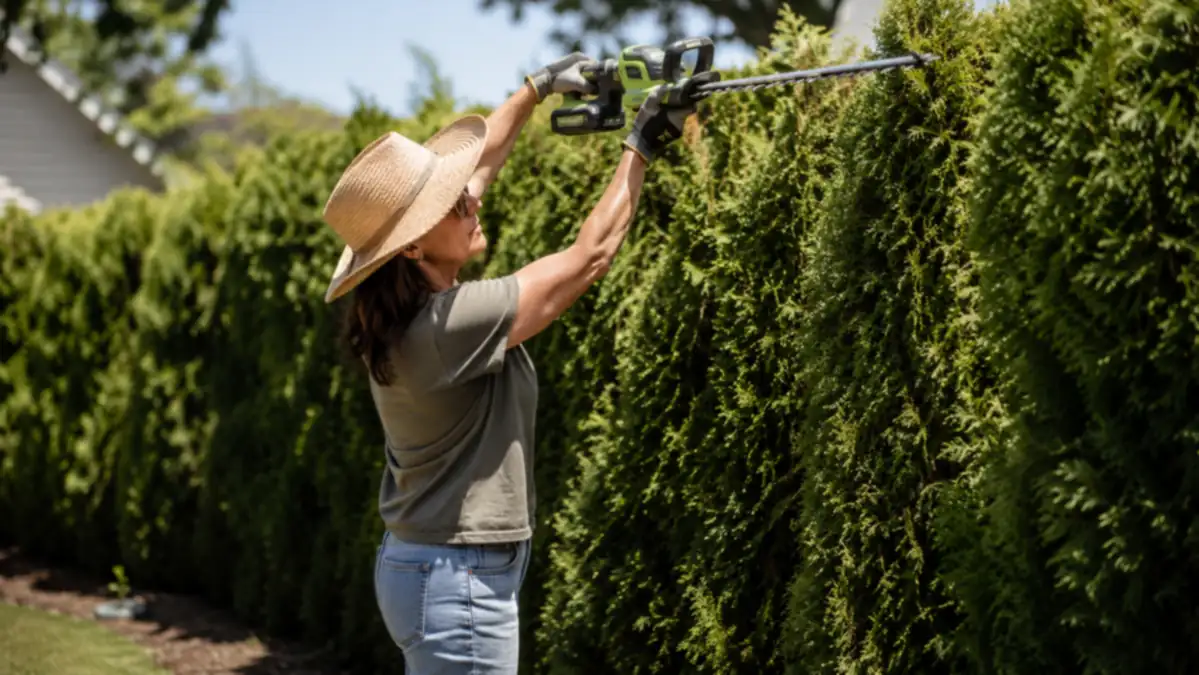
I also noticed the trimmer gets noticeably front-heavy when you extend it fully overhead, which mattered on Gail's taller sections of arborvitae, some of which top out around six feet. At 5.5 pounds it's light for a hedge trimmer, but holding that weight at full arm extension for a sustained stretch is a different kind of tired than trimming a chest-height hedge, and my forearm was feeling it by the end of that Saturday in a way it never had on my own lower hedges.
Neither of us wore ear protection that day since it's genuinely quieter than a gas trimmer, but it's not silent either, there's a steady mechanical whine that carried across Gail's yard enough that her next door neighbor came out to see what was going on. If you're the type who likes to knock out yard work before eight on a weekend, it's polite enough, but don't expect library quiet.
Where It Actually Won Me Over
None of that means I regret buying it, and here's why. On the forsythia and lilac, both hedges with thinner, more manageable branches, this trimmer flew. The dual-action blades cut clean on the first pass almost every time, no tearing or shredded leaf edges the way I sometimes got with dull manual shears. My chart above shows roughly how much faster it moved compared to hand shears on the same sections, and the gap isn't small. What used to be a forty-five minute chore on the lilac screen dropped to under fifteen minutes.
The lack of a cord matters more than I expected too. My side fence line runs past two flower beds and a rain barrel, and with my old corded trimmer I was constantly stopping to reroute the cord around obstacles. This one, I just walk the length of the hedge without thinking about it. That alone saved me real time and a fair amount of frustration on a hedge that isn't even that long.
I'll also say the price point makes the single-battery limitation easier to accept once you weigh it against the alternative. If you want the full breakdown of how this stacks up against a gas-powered hedge trimmer, including noise, weight, and maintenance, I laid that out separately in my WORX cordless versus gas hedge trimmer comparison. Short version, gas gives you more raw power and no charge-time gap, but you're trading that for fuel mixing, noise, and a heavier tool. For most suburban hedges, I think the tradeoff still favors this trimmer, single battery and all. Check today's price on Amazon if you want to see how it's currently priced against those gas alternatives.
If you want the longer view of how it holds up across a full growing season rather than just my three-hedge test, I wrote a separate piece after using it for six months straight, my long-term WORX hedge trimmer review, which gets into how the battery capacity changes over repeated charge cycles.
What I'd Do Differently Next Time
Knowing what I know now, I'd have bought a second battery at the same time as the trimmer instead of waiting to see if I needed one. WORX sells compatible replacement batteries separately, and having a spare charged and ready would have saved that ninety minute wait during Gail's arborvitae job. It's an extra step and a bit more to budget for up front, but if you've got more than one hedge run or a yard bigger than a typical quarter acre lot, I think it's worth doing from day one rather than learning the lesson the way I did.
I'd also plan my trimming days around the battery rather than around my own schedule. Instead of setting aside a single afternoon and hoping to power through everything, I now split bigger jobs across two shorter sessions, or I start the charger the night before so I've got a full charge waiting first thing in the morning. It's a small mindset shift, but it turns the single-battery limitation from a surprise into a non-issue.
What I Liked
- Clean, even cut on thin to medium branches, noticeably better than dull manual shears
- Lightweight at 5.5 pounds, manageable for most hedge heights
- No cord to manage or reroute around flower beds and obstacles
- Dual-action blades cause less hand vibration than a single-action design
- Runs quieter than a gas trimmer, reasonable for early weekend use
Where It Falls Short
- Ships with only one battery, no spare included or bundled
- Full recharge takes long enough to interrupt a large single-day trimming job
- Two-handed trigger safety switch can tire your grip on long sessions
- Struggles on thick, interwoven growth like mature arborvitae interiors
- Gets front-heavy and harder to control at full overhead extension
- Plastic blade guard isn't built for rough handling or tossing in a truck bed
- Charger cable is short, may need an extension cord to reach an outdoor outlet
I found out about the single battery the hard way, standing halfway through a lilac hedge with forty feet of arborvitae still waiting.
Who This Is For
This trimmer makes sense for anyone maintaining a typical home hedge, forsythia, lilac, boxwood, privet, or similar fine-branched shrubs, who trims every few weeks through the growing season rather than tackling one massive annual overhaul. It's especially worth it if you're currently working with dull manual shears and dealing with hand or wrist fatigue, because the difference in effort is real. If your hedge runs are under about 40 to 50 linear feet and you can plan your trimming day around a possible mid-session charging break, this is a genuinely solid, honestly-priced tool. It's also a good fit if you're helping a neighbor or family member with a smaller hedge job now and then, since it's light enough to hand off without a lesson in how to hold it.
Who Should Skip It
If you've got a long, dense hedge run like Gail's arborvitae screen, something you need to finish in a single sitting without interruption, the single-battery limitation is going to be a real annoyance rather than a minor quirk. You'd be better served by a model that includes two batteries, a swappable battery system, or a gas trimmer if the run is long enough. If you have grip weakness or arthritis that makes sustained trigger pressure uncomfortable, it's worth testing the two-handed switch in person before you commit, because that continuous grip requirement is not something everyone will love. And if your hedges have grown seriously overgrown with thick, woody interior branches needing hard renewal cuts, start with loppers or a pruning saw first, this trimmer is built for shaping and maintenance, not heavy structural cutback.
Now you know the parts the listing leaves out. Here's whether it's still worth it.
For most suburban hedges, the honest tradeoffs here are worth accepting for the clean cut and the freedom from a cord. Check today's price on Amazon and decide for your own yard.
Amazon Check Today's Price on Amazon →