
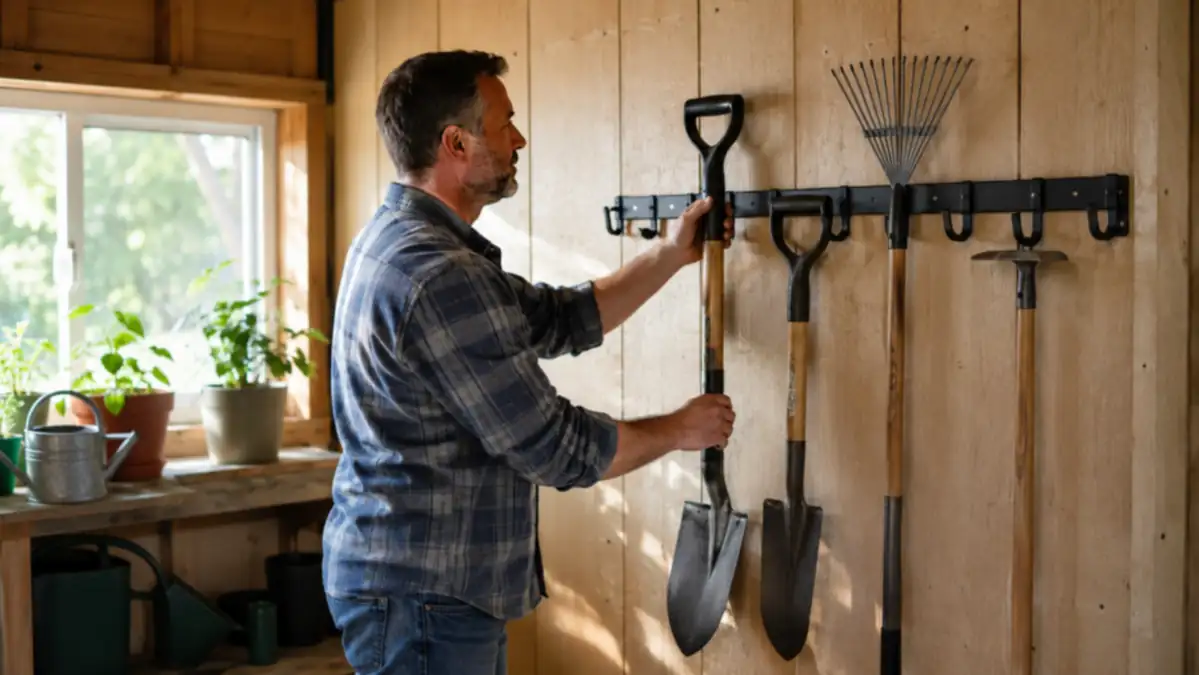
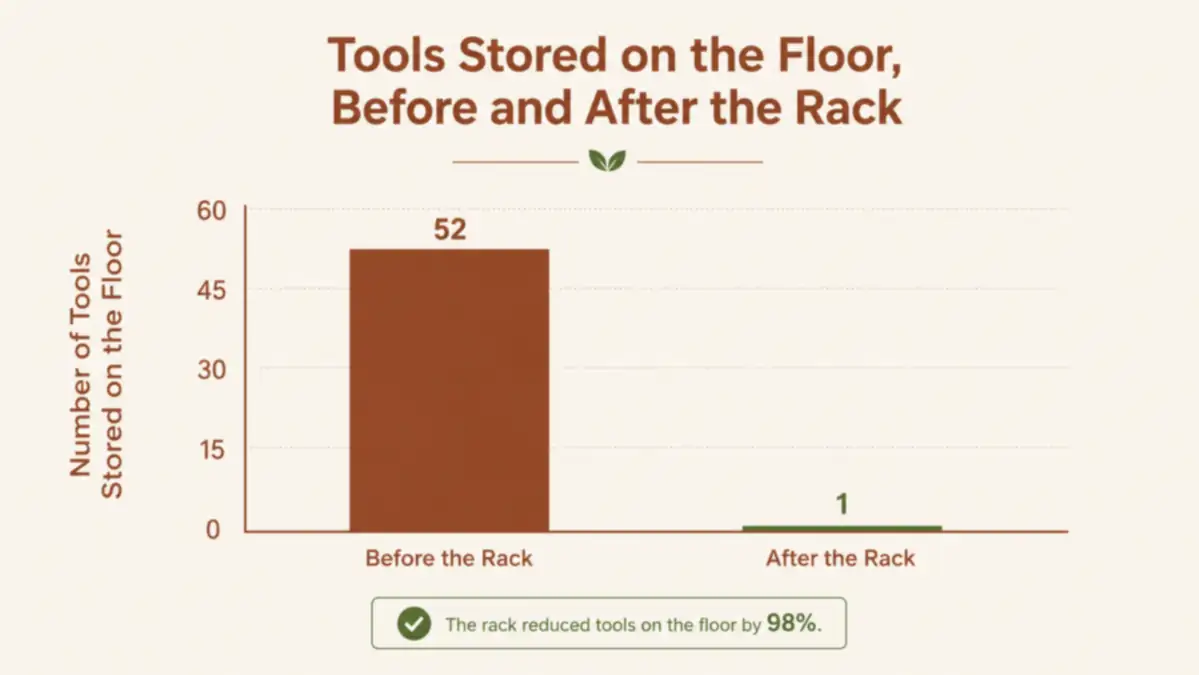
My shed used to be a place I avoided after about four in the afternoon, because that's when the light got low enough that I couldn't see what I was about to trip over. Shovels leaning in the corner, a rake that always seemed to fall the second I opened the door, a hoe wedged behind the wheelbarrow where I'd forget it existed until I needed it. I'd owned this house for eleven years and never once had a real system for the tools I use every week. Last spring, after stepping on the tines of a rake for what felt like the hundredth time, I finally ordered the StoreYourBoard 36-inch wall-mounted tool rack and bolted it into the shed wall on a Saturday morning.
It's been a full year now, four seasons of spring cleanup, summer weeding, fall leaf hauling, and the odd January thaw when I go out to check on the raised beds. I want to walk through what actually held up on this rack, what surprised me, and where I think it falls short, because a rack that looks tidy in the first week and sags by August isn't worth the wall space it takes up.
The Quick Verdict
A sturdy, genuinely useful wall rack that got every long-handled tool off my shed floor and kept them there for a full year without a single hook loosening or a single tool crashing down.
Amazon Check Today's Price →Tired of stepping on rake tines every time you walk into your shed?
The StoreYourBoard rack got my shovels, rake, and hoe off the floor in about twenty minutes on a Saturday morning. Check today's price on Amazon before you trip over another tool.
Amazon Check Today's Price on Amazon →How I've Used It
My shed is a fairly standard eight by ten, wood-frame with plywood interior walls, and before the rack went up I had a rotating pile of tools leaning against every flat surface. A round-point shovel, a flat spade, a bow rake, a garden hoe, a pair of long-handled loppers, and by mid-summer my cordless hedge trimmer joined the pile too because I never got around to finding it a proper spot. I mounted the StoreYourBoard rack along the back wall, roughly at shoulder height, and hung the heaviest tools, the shovel and the spade, on the outer hooks where I could grab them without reaching past anything else.
Over the year I used the rack pretty much every week during the growing season, March through October, and less often through the winter months when the shed mostly holds snow shovels and salt. I kept an eye on how the hooks handled repeated use, how the wall anchors did with the seasonal humidity swings a shed goes through, and whether the whole thing stayed level after a year of tools going on and off it dozens of times.
The short version is that it held up better than I expected. I've had cheap pegboard hooks bend under a shovel's weight before, and I half expected the same disappointment here. It didn't happen. The rack is still level, every hook is exactly where I mounted it, and the wall anchors haven't budged even after a full season of humid summer air working on the drywall screws behind them.
Weight Capacity and the Rubber-Coated Hooks
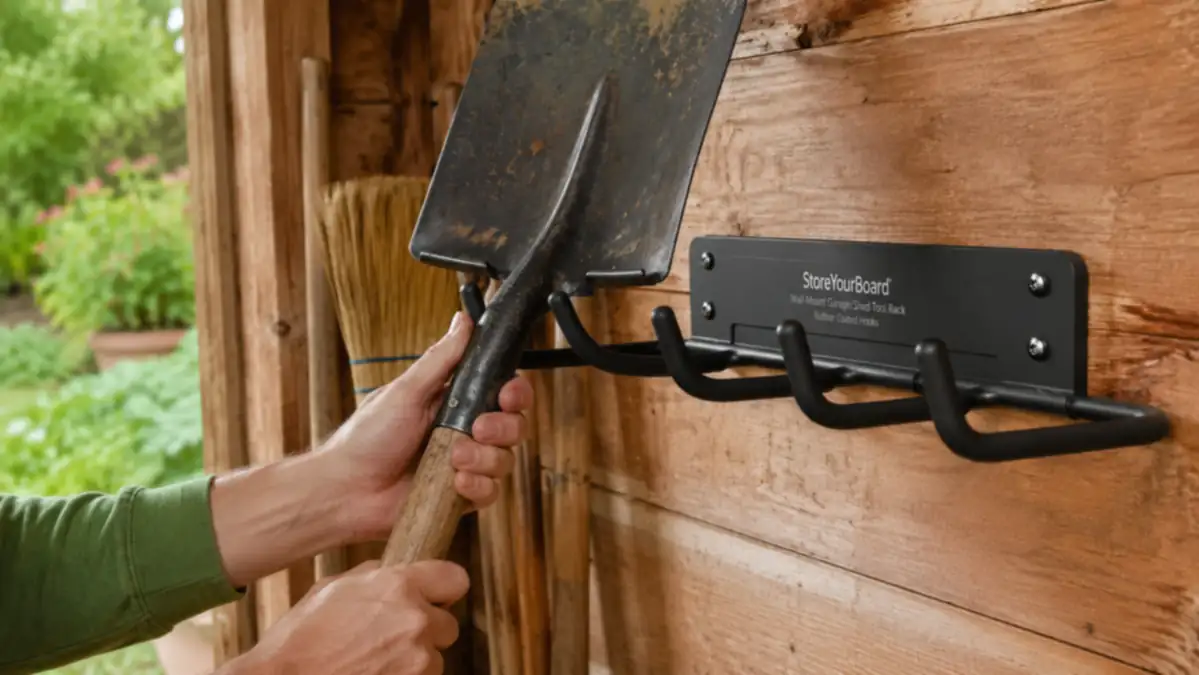
This rack is rated to hold 250 pounds across its full 36-inch length, which sounded like overkill when I first read the spec, but it makes more sense once you actually load it up. A round-point shovel with a fiberglass handle weighs about five pounds, a bow rake maybe four, so on paper you'd need close to fifty tools to test that rating. What the high capacity actually buys you is peace of mind that a single heavy tool, like a full-size digging fork or a long-handled post hole digger, isn't going to stress a single hook past its limit the way it might on a flimsier rack.
The hooks themselves are steel with a rubber coating, and that coating is the detail I've come to appreciate most over the year. My old system, back when I had one, was a couple of bent nails hammered into a stud, and every tool handle I hung on those nails eventually picked up a scuff or a dent where the bare metal dug in. The rubber coating on these hooks spreads the contact point out and doesn't bite into wood or fiberglass handles the way a bare hook does. A year later, none of my handles show the kind of wear marks I used to get from the nail-and-a-prayer method.
I did notice the rubber coating on my two most-used hooks, the ones holding the shovel and the rake, has flattened slightly where the handles rest, but that's cosmetic. It hasn't cracked, peeled, or exposed the metal underneath, and the hooks still hold the tools securely. For a rack that sees weekly use in a shed with no climate control, I think that's a reasonable amount of wear to expect.
A Year on the Wall: Rust, Wobble, and What Actually Held Up
I live somewhere with real seasons, so my shed goes from a humid, sticky July to a dry, cold January, and that swing is hard on anything metal that isn't properly finished. I checked the rack closely at the six-month mark and again just before writing this, looking specifically for rust starting at the hook bases or anywhere the black finish had chipped during mounting. I found none. The finish on this rack has held up better than the finish on a set of wall brackets I installed in my garage a few years back, which started showing rust freckles within the first winter.
The bigger worry for any wall rack isn't the finish, it's whether the mounting stays solid once real weight and repeated use get involved. I mounted mine into two wall studs using the included screws, and I want to be honest that this matters more than people expect. If you only have drywall anchors to work with because your studs don't line up with the rack's mounting holes, you're going to want heavier-duty anchors than whatever comes in a typical hardware store bag, because a 250-pound rating on the rack doesn't mean much if the wall behind it can only hold a fraction of that.
With mine anchored into studs, there's been zero wobble, zero sag, and zero movement even when I've hung something slightly off-balance, like a long-handled edger that likes to swing when the shed door opens. I check the mounting screws every few months out of habit more than necessity at this point, and they've stayed snug the whole time.
Mounting It in an Afternoon
I'm not particularly handy, and I want to say that plainly because a lot of tool storage reviews are written by people who mount things for a living. Installing this rack took me about twenty minutes once I found my stud finder, which took longer than the actual mounting. The rack ships with mounting hardware, a level line printed right on the packaging that I used to keep the first hole straight, and instructions that didn't require me to guess at anything.
The 36-inch length worked well for the back wall of my shed, where I had a clear run without a window or shelf bracket in the way. If your shed is narrower or you've got obstructions, it's worth measuring the actual wall space before you order, because a rack that's too long to sit flush ends up looking crooked no matter how carefully you level it. Mine fit with a few inches to spare on either side, which also gave me room to add a second, smaller hook rack later for hand tools like my trowel and hand cultivator.
What Else I Considered
Before I settled on a wall-mounted rack, I looked seriously at a freestanding tool caddy, the kind with slots and a bucket base that you just set on the floor and drop tools into. They're tempting because there's no drilling involved and you can move them around the shed or even out to the garden if you want. But every freestanding caddy I looked at either tipped when a single heavy shovel was leaned in at an angle, or it still ate up floor space I was trying to reclaim in the first place. I laid out the full tradeoffs in a separate wall rack versus freestanding tool caddy comparison if you're weighing the same decision I was.
I also thought about just adding more pegboard, since I already had a sheet up near my workbench. Pegboard hooks are cheap and flexible, but in my experience they loosen over time, especially with heavier tools, and the hooks themselves aren't rated for anything close to what this rack handles. If you want the fuller case for going wall-mounted over any floor-based system, I wrote up ten specific reasons in a separate piece on why a wall-mount tool rack saves space in a small shed, most of which held true for me over this past year.
I never look at just the number on the price tag when I'm weighing a purchase like this. What matters more is what a rack costs you over a year in frustration, tools you can't find, a floor you're constantly tripping over, hooks that bend the first time you load them. This one hasn't cost me any of that, and I think that's worth more than saving a little at checkout. Check today's price on Amazon if you want to see where it lands right now.

Where It Falls Short
No storage rack is perfect for every shed, and I'd rather tell you the real limits than pretend it's flawless. The fixed hook spacing is the first thing worth knowing. The hooks are evenly spaced along the 36-inch bar, which works great for tools with standard handle widths, but if you're trying to hang something unusually bulky, like a wide-tined leaf rake right next to a bulky post hole digger, you may find the neighboring hooks crowd each other more than you'd like.
The second limit is that this rack is built for long-handled tools. It does nothing for hand tools, gloves, seed packets, or the dozen small items that also clutter up a shed. I ended up adding a small second rack for that category, which I don't count against this one since it was never designed to be an all-in-one system, but it's worth planning for if your shed's mess includes more than shovels and rakes.
And as I mentioned, mounting into anything other than solid studs is going to test the rack's real-world capacity more than the spec sheet suggests. If your shed walls are thin paneling over open framing with no easy stud access, plan on a bit more mounting work, either finding blocking behind the wall or using proper heavy-duty anchors, rather than assuming the included hardware alone will get you to that 250-pound number.
What I Liked
- Rubber-coated hooks protect handles without denting or scuffing them
- Held its finish for a full year with no rust, even through a humid summer
- Zero wobble or sag once mounted into wall studs
- Mounting took about twenty minutes with no special tools
- 250-pound rating means one heavy tool never stresses a single hook
Where It Falls Short
- Only handles long-handled tools, not gloves, hand tools, or small items
- Fixed hook spacing can crowd unusually bulky tool heads
- Real capacity depends heavily on hitting solid studs when mounting
- 36-inch length needs a genuinely clear wall run to sit flush
A year later, none of my handles show the kind of wear marks I used to get from the nail-and-a-prayer method.
Who This Is For
If you've got a shed or garage wall that's collecting leaning shovels and rakes the way mine used to, and you've got at least one stretch of studs you can mount into, this rack earns its spot on the wall. It's especially good if you're tired of tripping over tools every time you walk in, or if you've had cheaper hooks bend or rust on you before. Anyone who wants their long-handled tools visible and grabbable in a couple of seconds, rather than dug out from a pile, will notice the difference the first week.
It's also a solid fit if you're setting up a shed for the first time and want a system that won't need replacing in a season or two. Mounting it once, correctly, into studs means you're not revisiting this project again next spring.
Who Should Skip It
If your shed or garage walls genuinely don't have accessible studs anywhere near where you need storage, and you're not willing to open up the wall or add blocking, you may be better served by a freestanding option, even with the tradeoffs that comes with. And if most of your clutter is hand tools, hoses, and small supplies rather than long-handled shovels and rakes, this particular rack isn't going to solve your main problem, you'd want something built for smaller items instead.
If you're renting and can't drill into the walls at all, this isn't the right tool for your situation either, no matter how well it performs, since the whole system depends on a secure, permanent mount.
A year in, my shed floor is finally just a floor again.
If you're done tripping over shovels and rakes every time you open the shed door, don't spend another season living with the clutter. See today's price on the StoreYourBoard wall rack on Amazon.
Amazon Check Today's Price on Amazon →