
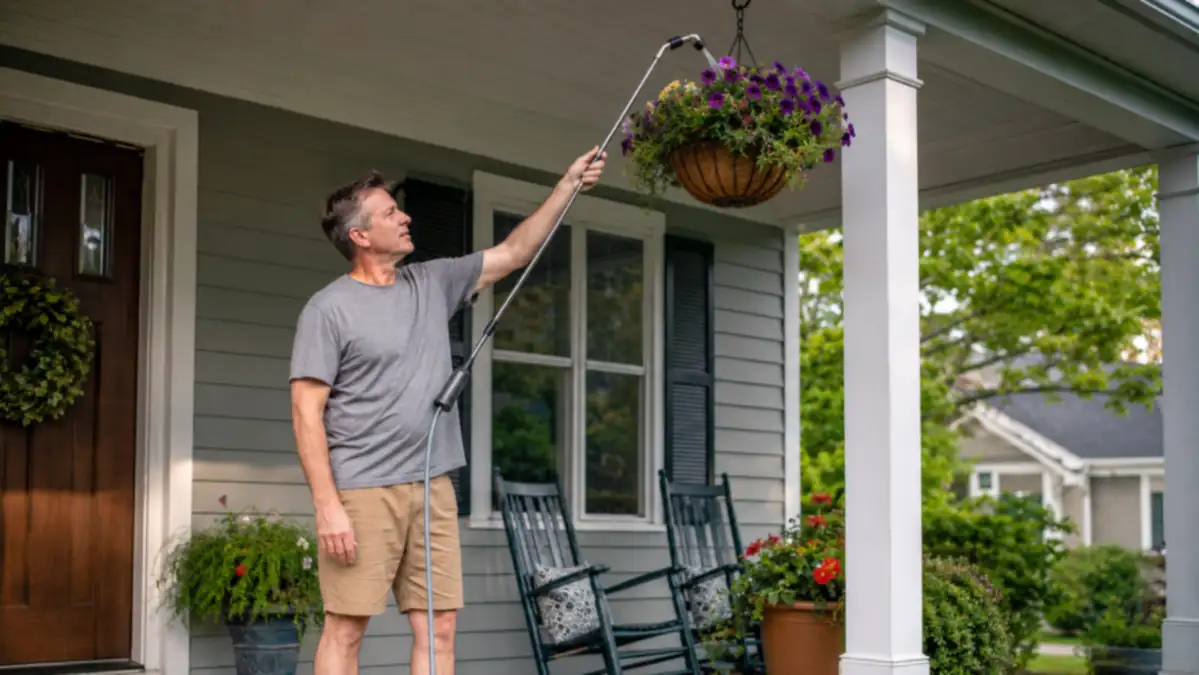
For two summers I hauled a wobbly aluminum step ladder across my patio every single morning just to reach the two baskets hanging off the porch beam by my front door. The ladder always seemed to land on one uneven paver, so it rocked a little every time I stepped up with a full watering can in one hand. One morning it slid an inch on a wet spot and I came down harder than I'd like to admit, can and all, soil and water everywhere. That was the morning I decided there had to be a better way to water hanging baskets that didn't involve balancing on a ladder before I'd even had coffee.
There is a better way, and it doesn't cost much or take long to set up. The short version is a long-reach watering wand that lets you stand flat on the ground and get water, and your eyes, right up into the basket where the soil actually is. But getting a hanging basket properly watered is about more than just reaching it. It's also about knowing when it's actually dry, watering slowly enough that the water soaks in instead of running straight through and out the drainage holes, and doing it at the right time of day so you're not scorching leaves or inviting rot. Here's the full process, ladder-free, that I've used every summer since.
The tool that got me off the ladder for good
A 24-inch watering wand with a real shutoff at the grip is what made this whole method possible for me. The Green Mount wand reaches up into a basket hung from a porch beam or bracket without me leaving the ground, and the stainless head breaks the water up gently instead of blasting the soil out from under the plant. It's the single change that ended my ladder habit.
Amazon Check Today's Price on Amazon →Step 1: Check whether the basket is actually dry before you water it
This sounds obvious, but it's the step that trips up most people watering hanging baskets, including me for the first few summers I grew them. The soil surface in a hanging basket dries out fast because it's exposed to sun and wind on all sides, sometimes within an hour or two of a good soaking. If you're watering by how the surface looks, you'll end up watering way more than the plant actually needs, and overwatered hanging baskets rot at the roots just as fast as underwatered ones wilt.
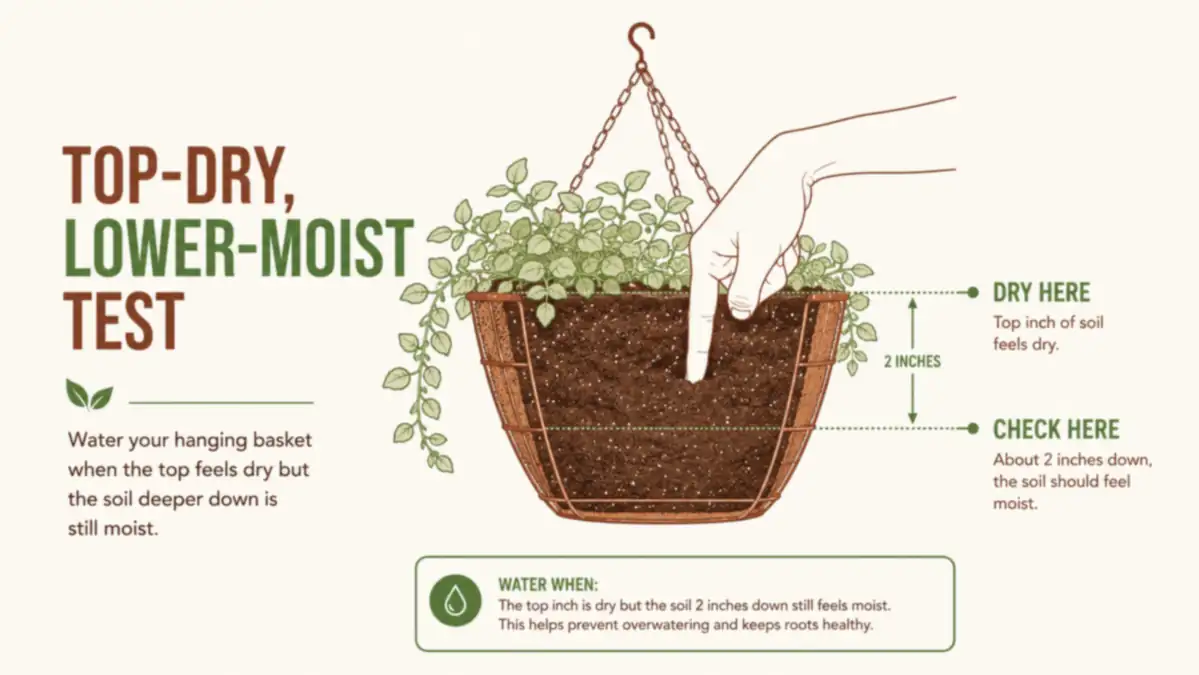
The better test is to press a finger into the soil about two inches deep, right up near where it hangs, not from the ground. If you can reach the basket with your hand at all, do the test there. If it's too high to reach, which is usually the whole reason you're avoiding it, use the tip of the watering wand itself, dry, with the water off, to press gently into the soil surface and feel the resistance. Dry soil feels loose and gives easily. Moist soil two inches down has some firmness to it and you can usually feel a slight coolness even without touching it directly. If the top inch is dry but two inches down still has moisture, I usually wait another few hours before watering rather than soaking it again.
A basket that dries out and wilts hard between waterings, leaves drooping over the rim by afternoon, is telling you it's outgrown its pot or it's in a spot with more sun and wind than the soil volume can handle. That's a different problem than a watering schedule problem, and I'll get to what helps with that later on.
Step 2: Water early in the day, before the heat sets in
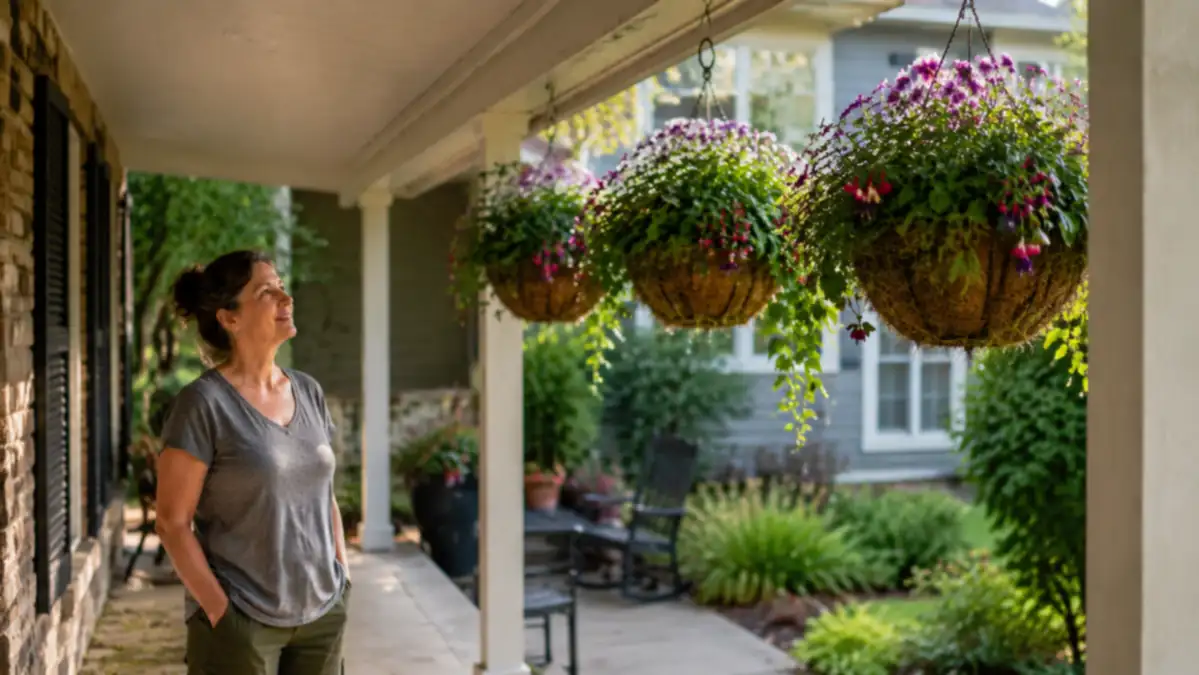
I water my hanging baskets before eight in the morning whenever I can manage it, and it's made a real difference compared to the years I watered whenever I got around to it, often mid-afternoon after work. Watering in the cool of the morning gives the plant all day to take up what it needs before the heat of the afternoon pulls moisture back out of the soil through evaporation. Water that goes on in the evening instead sits on wet leaves and damp soil overnight, and in my climate that's an invitation for fungal problems, especially on petunias and other baskets with dense foliage that doesn't dry out well in still night air.
Midday watering isn't dangerous the way old garden folklore claims, water droplets don't actually burn leaves like little magnifying glasses, but it is wasteful. A big share of the water you put on in the heat of a summer afternoon evaporates before the roots ever get to use it, so you end up watering more often for the same result. Early morning just gets more value out of the same amount of water, and for baskets you're already reaching with some effort, that matters.
Step 3: Set your ground position before you extend the wand
This is the safety point that the ladder method skips entirely, and it's the whole reason this approach exists. Find a flat, stable spot on the ground, not gravel, not a slope, not a wet paver, directly under or just to the side of the basket, close enough that the Green Mount at full extension reaches comfortably without you leaning or stretching onto your toes. If you find yourself stretching, step closer instead of reaching farther. A watering wand with a 24-inch reach usually gets you there from solid footing on a normal porch, but every setup is a little different depending on how high the bracket is mounted.
This is worth spelling out because it's exactly the scenario a ladder makes dangerous. A wet ladder foot on a smooth porch or patio surface is a slip waiting to happen, and you're holding a hose or a can with one hand while trying to balance with the other, often reaching overhead which is the worst position for stability. Standing flat on the ground with both feet planted and using the wand's length to do the reaching instead of your own balance removes that risk completely. I haven't touched my step ladder for watering since I started doing it this way, and that's really the point of this whole guide.
Step 4: Water slowly so it soaks instead of running straight through
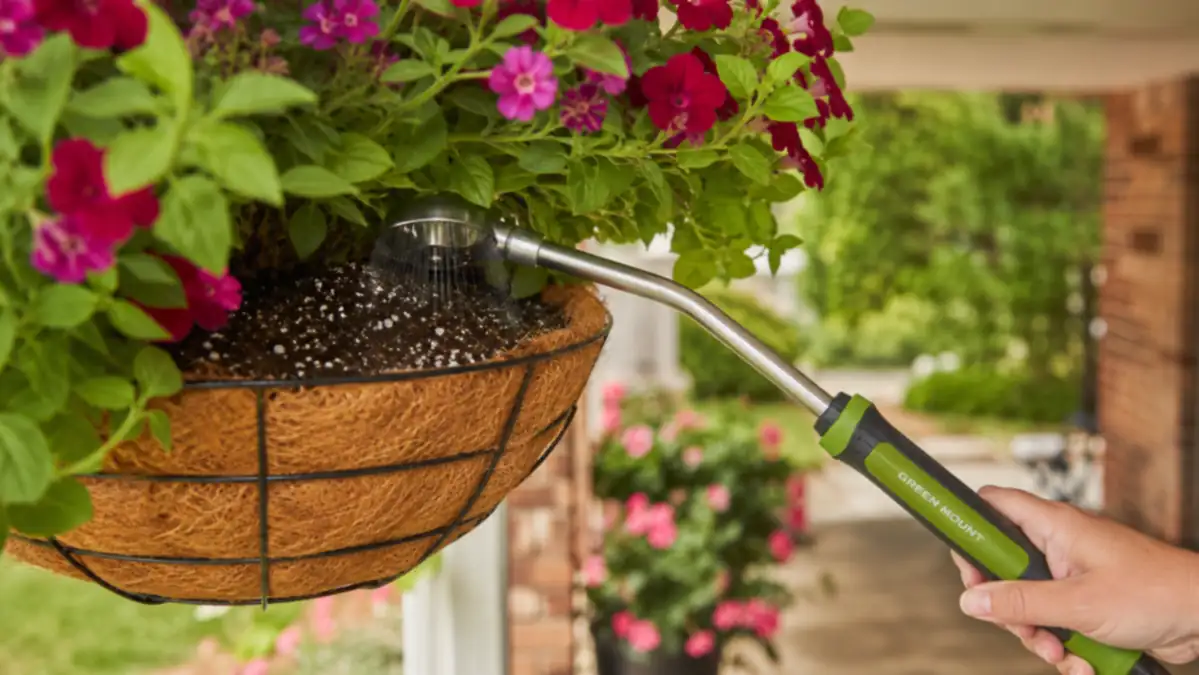
Once you're in position, angle the Green Mount head up and in under the foliage so the water lands directly on the soil surface rather than raining down over the top of the leaves and flowers. This does two things. It keeps water off petals and leaves, which cuts down on fungal spotting and knocked-off blooms, and it means more of the water you're using actually reaches the roots instead of getting caught and shed by dense foliage before it ever hits the soil.
Go slow. This is the part people rush the most, especially with a basket they've been avoiding because of the reach. If you blast a hanging basket with a hard, fast stream, the water runs straight down the inside wall of the pot and out the drainage holes in seconds, without ever fully wetting the root ball in the middle. That's why a basket can look watered, water dripping from the bottom, and still be bone dry two inches in at the core. A gentle, broken-up spray pattern from a shutoff-equipped wand lets you control the pace, applying water in a slow, steady soak and pausing when you see it start to run out the bottom, then giving it a minute to absorb before adding a bit more if the basket still feels light.
A basket that's fully saturated will feel noticeably heavier than a dry one if you lift or nudge it slightly, and it should hold that weight and slowly lighten over the following day or two rather than drying out again within hours. If yours is drying out within a few hours no matter how thoroughly you soak it, that's usually a sign the pot has gotten root-bound or the potting mix has broken down and stopped holding water well, which is a repotting problem rather than a watering technique problem.
Step 5: Adjust the shutoff and check the far side, don't just walk away
Most hanging baskets aren't watered evenly on the first pass, especially trailing varieties like petunias or lobelia where the foliage cascades over the rim and hides part of the soil surface from view. Before you consider the job done, use the shutoff at the wand's grip to pause the flow, step slightly to one side, and check the far edge of the basket where you might not have gotten good coverage. I learned this one the slow way, watering the near side of a basket thoroughly for a full season while the back half, angled away from where I stood, stayed chronically underwatered and eventually thinned out.
The shutoff at the grip is worth using deliberately here rather than just holding the trigger down the whole time. Pause between passes around the basket, let water settle and soak in, then resume for a second light pass if the first one didn't produce runoff evenly all the way around. It only takes an extra thirty seconds per basket and it's the difference between a basket that grows evenly on all sides and one that looks lopsided by midsummer.
What Else Helps
If your baskets are drying out faster than a normal watering schedule can keep up with, even with good technique, a few things tend to be the real cause. Baskets in a lot of direct afternoon sun and wind, especially on a covered porch where rain never reaches them naturally, dry out much faster than baskets in a more sheltered spot. Moving a basket even a few feet, or adding a saucer underneath to catch and slow-release some runoff, can stretch the time between waterings noticeably. For more on why a proper watering wand outperforms the spray nozzle most people default to for this job, I covered the mechanics of it in 10 reasons a watering wand beats a spray nozzle, which gets into why the softer, more directed spray pattern matters for hanging baskets specifically.
A wand with a decent shutoff also saves you a surprising amount of water over a season, since you're not standing there holding a full-blast trigger the whole time waiting to see runoff. If you want the fuller picture on how this specific wand has held up for me across a whole summer of daily hanging basket duty, watering wands aren't all built the same and mine took a bit of trial and error to land on, I laid all of that out in my honest review of the Green Mount watering wand.
You don't need a ladder to reach a hanging basket properly. You need a wand long enough to do the reaching for you, and the patience to water slow enough that it actually soaks in.
Tired of dragging a ladder out for two baskets?
A long-reach watering wand solves the reach problem and the soggy-fast-runoff problem in one tool, and it means you can water safely from flat ground every single morning. The Green Mount's 24-inch stainless wand is what finally got my baskets watered properly without the balancing act.
Amazon Check Today's Price on Amazon →